(History)
Harishchandragad is one of the oldest forts in Maharashtra. The fort is quite ancient and very big too. Remnants of Microlithic man have been discovered here. The various Puranas (ancient scriptures) like Matsyapurana, Agnipurana and Skandapurana include many references about Harishchandragad. Its origin is said to have been in 6th century, during the rule of Kalchuri dynasty. It is said that the citadel (Balekilla) was built during that era. The various caves probably have been carved out in the 11th century. Though the peaks are named as Taramati and Rohidas, they are not related to Ayodhya. Taramati is known as second highest peak in Maharashtra at about 4500 feet of height from sea level. A Great saint Changdev (one who wrote the epic ‘Tatvasaar’) used to meditate here in 14th century. One can even see the ‘Samadhi Sthan’ of this saint behind the Harishchandreshwar Temple. This fort was under control of Yadavas, Mughals, Marathas and then British Raj.
The temples on fort and in the base village are of ‘Hemadpamthi’ type.
(Reach the Base)
There are total seven ways from four different base villages to reach Harishchandragad. The best, safe and easiest of all is from Khireshwar via Tolar Khind. There is another way to reach top from Khireshwar which goes from Nedhe (Niddle Hole) via Junnar Darwaja but this route is very difficult and it is suggested not to go by this route without any local guide. Following are the ways to reach Khireshwar from Mumbai and Pune. Mumbai-Kalyan-Malshej Ghat-Khubi Phata-Khireshwar and Pune-Nashik Phata-Bhosri-Aale Phata-Khubi Phata-Khireshwar. The distance between Khubi Phata and Khireshwar is 4KM and goes over the wall of Manikdoh Dam’s back water reservoir. There is bus service from Swarget to Khireshwar which leaves Swarget at 4.30 PM and leaves Khireshwar at 6.00AM. This is the only bus for Khireshwar which is direct from Pune; there is no direct option from Mumbai. One can reach Khireshwar in 3-4 hours from Pune and Mumbai respectively. From here, it takes about 4 hours walk including few rock patches to reach the fort top. Note that we don’t get drinking water in between so remember to carry at least 2 liter drinking water per head.
Nageshwar Temple near Khireshwar
This is a great antique construction, and diverse artistic works are seen on this. On the ceiling of the temple are beautiful carvings. The main attraction of the carvings here is the 1.5 m long sculpture of Lord Vishnu in the sleeping posture, popularly known as "Shesh-Shayyi Vishnu" in Marathi. It is rare and hence holds a lot of importance. There are a lot of legends told about this sculpture. There are caves near the temple.
(Ascend the Fort)
Ascending starts from the Khireshwar village and you can reach the caves on top in 4 hours walk. There are 2-3 rock patches on the way after Tolar Khind and one before it. In the middle of Khind, you can see the rock carved with a tiger’s image, this is called as ‘Vyaghra Shilp’. Remember to take left from this point as right turn will take you to another base village on opposite side of the mountain. While reaching this point, you can observe the vertically straight rocks of the fort. One can even enjoy the echo from the first rock patch before reaching this ‘Shilp’. Then starts the vertical rock patches, one has to be careful while climbing those patches else you will thrown in about 3000 feet deep valley. After these rocks, you will reach the first section of fort where you can get network coverage for your mobile. From this place there can be seen two ways, which is divided by the huge citadel before you, one goes to the Junnar Darwaja (i.e. to Khireshwar) from left side of citadel and another will take you to Caves on fort from right side if Citadel. You can observe the walls of Citadel from here. There is nothing special or different to have a look on Citadel that’s why many trekkers don’t go over there. There is a small water tank and few ruins of wall of the fort on Citadel. After walking through few small mountains and a little forest area you will reach the main part of the fort leaving behind the Citadel. Note that, you can find many stones which are naturally so different and attractive. If you are lucky enough, you can also witness some animal hunting too as we saw.
(About Fort and Sightseeing)
Once reached the place from where you can see the Temples and Caves, you can observe the small temples and few ruined rocks. On one of the small rock, you can see the image of some man with water containers on his shoulder. This is Raja Harish Chandra’s statue that is shown filling water at a poor man’s house. From this place, there are four ways, one goes to Caves, one goes to Main Temples, one goes to Taramati and last one goes to another base village on other side of the fort. I would suggest you to go to caves from here, put down your bags and get some rest and food. Then you go to see the Harishchandreshwar Temple, Kedar Ling (Kedareshwar Temple cum Cave), Pushkarni Lake and Saptatirtha which are all nearby. There are other few small and half broken temples of lord Ganesh, Shiva and Vishnu in same premises. The notable thing about this huge fort is that it has no door now. There were two doors in ancient time named ‘Junnar Darwaja’ (beside citadel) and ‘Maha Darwaja’ (behind Konkan Kada) but both are broken and almost not viewable now.
Saptatirtha Pushkarni
To the east of the main temple is a well-built lake called “Saptatirtha Pushkarni”. On its bank are temple-like constructions in which there are idols of Lord Vishnu and Siva. Recently these idols have been shifted in the caves inside the temple of Harishchandreshwar. The water in the pond is not in good condition following some waste material thrown by many trekkers.
Kedareshwar Cave
Going rightwards of Harishchandreshwar temple, we come across a huge cave. This is the cave of Kedareshwar, in which there is a big Shiv Ling, which is totally surrounded by water. The total height from its base is five feet, and the water is waist-deep. It is quite difficult to reach the Shiv Ling, as the water is ice-cold. There are sculptures of marriage of Shiva-Parvati are carved out here. In monsoon it is not possible to reach this cave, as a huge stream flows across the way. The origin of a river named ‘Mangal Ganga’ is near this cave.
Konkan Kada
The most interesting point on this fort is this cliff, which has always fascinated many people from many years. The cliff faces west and looks down upon the Konkan. From here, one can have a breathtaking view of the surrounding region and the setting sun. This cliff is not just vertical; it is an overhang, almost like a cobra's hood. It has been climbed many times. The first climb was in 1985 by a group from IIT Bombay (V. V. Limaye, Jayant Kulkarni, Girish Sant, Anand Pai, and others). The second climb was in 1997 by a team from the Pinnacle group. Most recent (November 2006) climb was done by Giri Viraj Hikers group from Dombivali. Sometimes a circular rainbow called ‘Indravajra’ is seen from this point. It can be seen only when there is a bit of mist in the valley, and the sun is right behind the person facing the valley. One amazing phenomenon that can be observed at this place is the vertical cloud burst, in which the clouds nearing the cliff get sucked into the pit fall area below and are thrown vertically into the sky reaching more than 50 feet. It creates a magical wall that is rising straight from the edge of the cliff without entering the landmass area. The fog show and hovering clouds below the cliff complement the season if one visits. Seeing all this beauty, a person has jumped off form this place. A marble sheet with same information was installed near the right end of this place which is broken by unknown people. Two more routes come near this place from two different base villages. One of them is very popularly known as ‘Nalichi Vaat’.
Taramati Peak
This is the topmost point on the fort at about 4500 feet. It is the second highest peak in Maharashtra. From here we can have a glimpse of the whole range of Naneghat and Malshej Ghat and the forts near Murbad. One can also see the highest peak Kalsubai, Ratangad, Bhairavgad and Nanacha Angatha from here.
Caves on Harishchandragad
These caves are situated all over the fort. Many of these are situated at the foot of Taramati peak & are the place of accommodation. A few are near the temple, whereas some are near the citadel and some far away in the forests. A 30 feet deep natural cave is on the northwestern side of the fort, to the right of Konkan Kada is recently found. Many other caves are still said to remain undiscovered. One of the caves is known as ‘Ganesh Guha’ as a huge sculpture of Lord Ganesh is caved in it.
Temple of Harishchandreshwar
This temple is marvelous example of the fine art of carving sculptures out of stones that prevailed in ancient India. It is about 16 m high from its base. Around this temple there a few caves & ancient water tanks. This water is drinkable. As I said above, the river Mangal Ganga is said to originate from one of the tanks located close to the temple. The top of the temple resembles construction with the north-Indian temples. A similar temple is situated in Buddha-Gaya. Here we can see many tombs, in which a typical construction is seen. These are built by well-finished arranging stones one on top of the other. A short distance away, another temple called Kashitirtha is located. The fascinating thing about this temple is that it has been carved out from a single huge rock. There are entrances from all four sides. On the main entrance there are sculptures of faces. These are faces of guards of the temple. On the both sides of the entrance is a Devnagri inscription, which is about saint Changdev. At the back side of this temple, a huge Nandi is placed. Behind this Nandi, there is a small underground room which is said to be ‘Samadhi Sthan of Changdev’. There are few ‘Havan Kund’ above this place. A very beautiful Ganesh Temple is adjacent to this temple.
(Descend the Fort)
This fort at least requires two days (1 night and 2 days) stay for a better experience. The best time to visit is post monsoon and starting of winter. Descending the fort is from same way as of ascending but one has to be careful while selecting the right/left turns in the jungle else you will be lost in jungle and then it may take much time to reach Khireshwar. I am posting some of the pictures taken by me when I visited this fort in June 2009.

Taramati - Second Highest Peak in Maharashtra

Konkan Kada

Different Elephants on the Walls of Temple

Harishchandreshwar Temple

Carving on Temple Walls

A Sanskrit Line Carved on Wall

King Harishchandra

Marriage of Lord Shiva and Godess Parvati

Kedareshwar Temple cum Cave
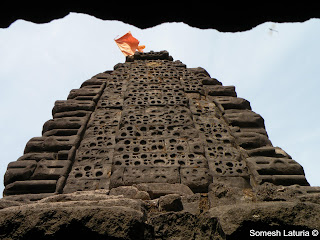
Harishchandreshwar Temple

A Click by Me

Just Another Angle

Shri Ganesh Temple on the Fort
 Many Bappas...Many Wishes...
 At least someone gets clean water...
 Feet of Lord Ganesh, where everybody bends and seeks blessings
 These hands are always ready to GIVE the best for our goodwill
 The blessing
 After the first Pooja
 Untouched look
 His Highness...
 He listens to everybody...
 And stores the pain and all bad things in his stomach